
Client
AXA Health Insurance España
My role
Product Lead, Backend + Frontend + Prototype
Team
Group of 4, IE MiM
Duration
4-week consulting sprint
The problem
A growing market nobody wanted to insure
Spain is aging fast, 20.4% of the population is already over 65, a figure projected to hit 30% by 2055. Yet traditional health insurance models were failing this segment entirely: premiums spiked with age, coverage was capped or denied past 65–70, and digital-first products excluded the very users with the highest healthcare needs.
AXA Health España faced a strategic crossroads: grow by continuing to serve the same working-age, urban, digitally-literate customer, or unlock the 9.5 million uninsured seniors who represented both a gap in the market and a moral failure of the industry.
The insight that shaped everything: 83.5% of elderly Spaniards live at home, not in institutions. Their adult children are already their de facto care coordinators. The product just needed to give those families a financial and digital infrastructure to do what they were already doing, more effectively.
The solution

AXA Multigenerational Care Plan Ecosystem
The core proposal was a two-layer product: a smarter risk engine on the backend feeding a more humane, multigenerational product experience on the frontend.
65+ risk clustering model
An unsupervised ML model groups elderly policyholders into health-risk clusters (A–E) using data across seven dimensions: clinical measures, body system profiles, behavioral data, healthcare utilization, cognition and functionality, and environmental factors. The model outputs a cluster assignment, top risk signals, and a recommended care pathway, feeding directly into AXA's pricing and service logic.
Module-based pricing for multigenerational families
Rather than individual age-based plans that priced seniors out, the ecosystem introduces a family plan logic, where a working-age adult can include elderly parents under one household policy. Pricing is modular (cognitive care, chronic disease, dental, caregiver support) rather than monolithic, making it affordable for families while sustainable for AXA.
Family Dashboard inside MyAXA
A new tab integrated into the existing MyAXA app gives three access tiers: the senior policyholder sees their risk score, upcoming check-ups, and telehealth access; the authorized caregiver receives alerts and can coordinate care; the family doctor views risk trend data and recommended intervention timing. Voice-assisted UX is available for lower digital-literacy users.
Rural access via Correos + pharmacy kiosks
For users outside urban digital infrastructure, the solution proposed enrolling through AXA's existing Correos partnership (Spain's 2,300 post offices) and deploying on-site health check-in kiosks at rural pharmacies, closing the physical access gap without requiring a smartphone.
Prototype
Built in Figma, presented to AXA stakeholders
The prototype demonstrated the Family Dashboard, the caregiver alert flow, and the risk score visualization across three user roles, senior, caregiver, and family doctor, used as the centerpiece of our final client presentation.
Screen tour
Five surfaces, one care ecosystem.
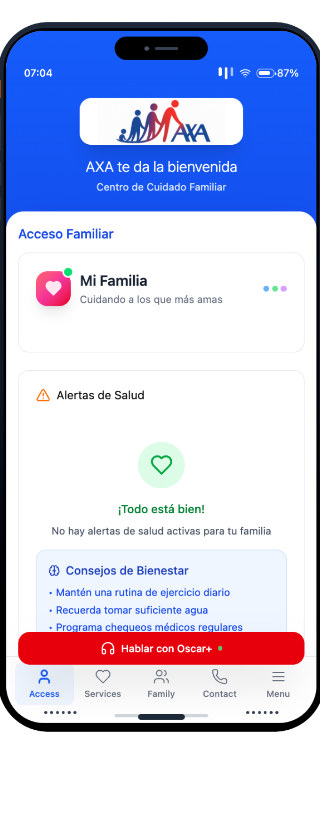
01 / 05
Family Access
Warm welcome hub with wellness tips and proactive health alerts.
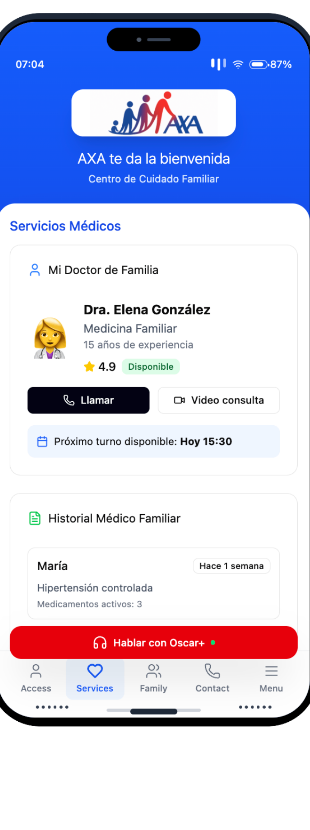
02 / 05
Family Doctor
One-tap access to a dedicated family physician, video consults, and shared medical history.
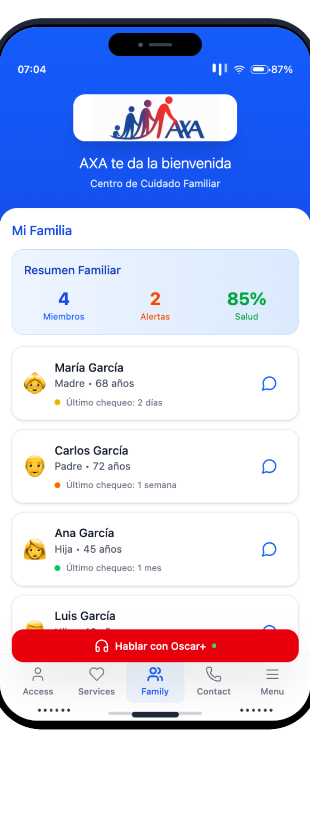
03 / 05
Family Dashboard
See every family member's health at a glance — alerts, check-ins, wellness score.
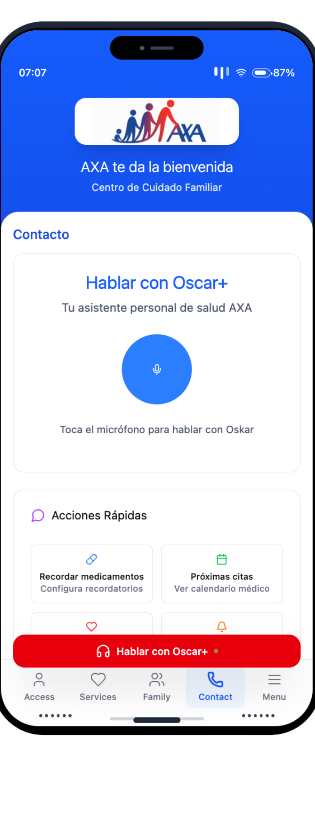
04 / 05
Oscar+ Voice Companion
Voice-first AI assistant designed for seniors who prefer talking over typing.
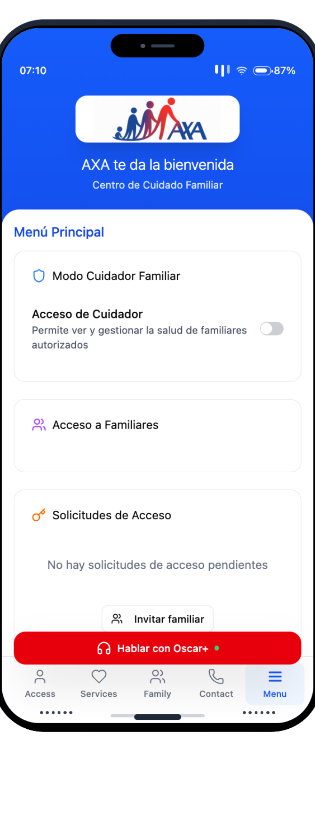
05 / 05
Caregiver Access Mode
Granular permissions let adult children manage a parent's health with consent.
Scroll horizontally →
My contribution
Product lead across the full solution stack
Within a four-person team, I took ownership of the product dimension of our recommendation, defining what we were actually building, how it would work technically, and what it would look and feel like for the end user.
Backend, Risk model design
Defined the architecture of the 65+ monitoring model: an unsupervised ML clustering system that segments elderly policyholders by health risk using clinical, behavioral, utilization, and environmental data, layered on top of AXA's existing GLM pricing engine as an augmentation, not a replacement.
Frontend, MyAXA app feature
Designed the customer-facing solution as an integrated module within the existing MyAXA app, a Family Health Dashboard with tiered access for the senior, a family caregiver, and the treating physician. Anchored the decision to extend an existing platform rather than build a standalone app.
Prototype, Concept design
Built the concept prototype demonstrating the Family Dashboard, caregiver alert flow, and risk score visualization, used as the centerpiece of our final client presentation.
Key product decisions
Choices that shaped the design
Extend MyAXA, don't build a new app
A new standalone app would have failed adoption with elderly users facing digital literacy barriers. Extending an existing trusted platform lowered onboarding friction and reused AXA's authentication, API, and medical record infrastructure, reducing both build cost and user confusion.
Augment GLM, don't replace it
AXA already used a GLM-based pricing engine. Rather than displacing it, which would require regulatory reapproval and internal resistance, the ML clustering layer was positioned as an external behavioral signal that enriches the existing model. This made adoption politically viable inside AXA.
Family as the purchasing unit, not the senior
Seniors on fixed pensions cannot afford private insurance at actuarially fair rates. Reframing the customer as the adult child, who already has income and motivation to care for aging parents, unlocked a viable willingness-to-pay dynamic and addressed the real decision-maker in 83% of cases.
How it compared to the market
What competitors were doing
- Age-capped plans, cutoff at 65–70
- Premium spikes that priced seniors out
- Digital-only with no rural fallback
- Standalone apps, new learning curves
- Reactive care, insure, then pay claims
What we proposed instead
- Multigenerational family plan, no age ceiling
- Modular pricing based on actual risk clusters
- Correos + pharmacy kiosks for physical access
- MyAXA extension, familiar, zero friction
- Predictive care, intervene before the claim
Outcomes
What we delivered
Projected €25M in incremental revenue potential against €12.25M in combined investment and operational costs, with a target break-even within 18 months of launch.
Solution presented to AXA Health España stakeholders as part of IE Business School's Tech Impact Lab, positioning AXA to address Spain's 9.5 million currently uninsured adults over 65.
Delivered a working concept prototype of the Family Dashboard, demonstrating the caregiver alert flow, risk score UI, and tiered access model used in the client presentation.
Designed a regulatory compliance framework for data use, distinguishing legally permissible medical-risk indicators from prohibited gender-based pricing, with GDPR-compliant consent and transparency flows baked into the product design.